
Ask a teacher what makes the job hard and one will almost never hear “the subject matter.” It is the room. Thirty students, thirty different moods and a lesson plan that looked flawless at 7 a.m. but now has to survive a Friday afternoon.
That gap between knowing your subject and actually leading a class is where good professional development earns its keep. Done well, teacher training does not pile more onto an already full plate. It makes the day-to-day job feel more manageable and one can see it in how students respond. Done badly, it is a long afternoon in a hall with a slide deck and a lukewarm cup of tea.
So, what separates the two? Here is what the research says, and what we think it means in real classrooms.
Why one-off workshops rarely change anything?
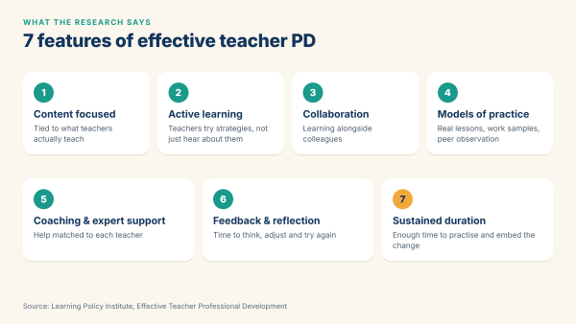
The Education Endowment Foundation (EEF) makes a similar point in its guidance on effective professional development. It explains that training is most effective when it strengthens teachers’ knowledge, keeps them motivated, provides practical strategies, and supports them in applying those strategies consistently over time. However, this final stage is often overlooked in schools. Teachers may receive useful training and understand what they need to do, but without continued guidance and support, they can struggle to put what they have learned into practice, particularly when challenges arise after the initial training.
What classroom leadership really means?
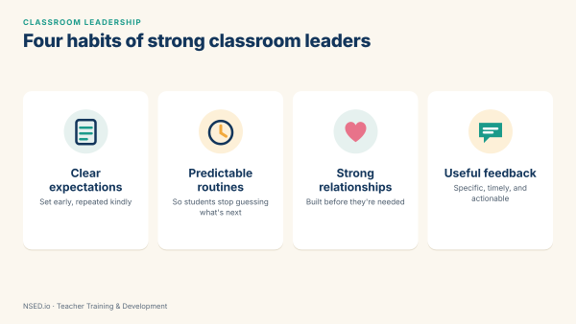
“Leadership” sounds like something for headteachers. In a classroom it is much smaller and much more daily. It is how you greet students at the door, how clearly, you explain what happens next, what you do in the ten seconds after someone calls out and whether students believe you will follow through on what you said. Strong classroom leaders tend to share a few habits. They set expectations early and repeat them kindly. They keep routines so predictable that students stop burning energy on “wait, what are we doing?” And they build relationships before they need them, because a student who feels known will usually give you the benefit of the doubt when you have to correct them.
These approaches may seem simple, but they can make a real difference in the classroom. The EEF’s guidance on improving behaviour in schools highlights the importance of understanding individual students, teaching positive learning behaviours, and maintaining clear and consistent classroom routines. Similarly, the Australian Institute for Teaching and School Leadership (AITSL) offers research-based insights into classroom management, providing further evidence on how teachers can create a positive and well-managed learning environment.
Consider two teachers delivering the same lesson to the same group of students. One begins by asking the class to settle down before getting started. The other stands at the classroom door, welcomes students as they arrive and directs them towards an activity already written on the board. By the time the bell stops ringing, the students are already engaged in their work. Although both teachers are teaching the same subject, the way they begin the lesson creates a very different classroom atmosphere. The difference is not simply a matter of personality or teaching style, it comes down to preparation, clear expectations and effective classroom management. The encouraging part? These are skills, not personality traits. Nobody is born able to move twenty-eight students from a group task to a class discussion without losing four minutes. You learn it, usually by watching someone who is good at it and then trying it yourself.
Skills that actually lift engagement
Student engagement is not always easy to judge. A quiet classroom does not necessarily mean that students are paying attention, just as a noisy classroom does not automatically indicate poor behaviour. What matters is whether students are actively involved in learning. When developing a teacher training programme, the following skills should be given particular attention.
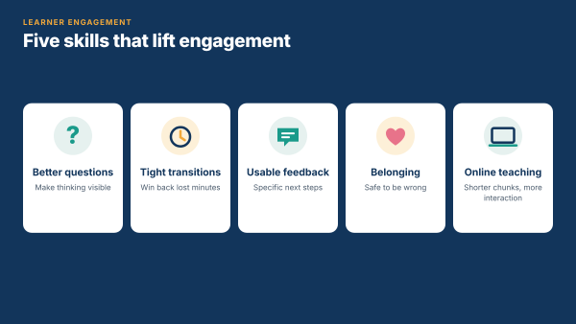
Asking better questions. “Does everyone understand?” gets you a wall of nodding. “What would happen if we changed this step?” gets you thinking you can actually see. Training in questioning (wait time, cold calling, quick checks for understanding) gives teachers a fast way to find out who is really following.
Running tight routines and transitions. The minutes between activities add up: handing out materials, getting started, moving into groups. Teachers who rehearse these moments, with a clear script and a trial run or two, often win back a surprising chunk of the lesson.
Giving feedback students can use. Feedback is one of the higher-impact approaches in the EEF’s Teaching and Learning Toolkit, though how it is delivered matters a lot. “Good job” does not move anyone. “Your second paragraph makes a claim, but I cannot see the evidence yet. What could you add?” does.
Building a sense of belonging. Students engage where they feel safe being wrong. Small things count: pronouncing names correctly, noticing effort rather than only results, checking in after a rough day. A teacher who treats a wrong answer as useful information rather than a small failure, quietly teaches the whole class that it is fine to try. That is when hands start going up on their own.
Teaching well online and in blended settings.
Virtual classrooms require the same teaching skills, but they need to be adapted to an online environment. Teachers should keep lessons shorter and more focused, include regular opportunities for student participation, and give clear instructions so learners can follow the lesson easily. Building trust and maintaining a connection with students is even more important online, as teachers cannot always see how students are responding. This has also explored in blog post on strengthening connections in virtual classrooms, which discusses practical ways to make online learning more engaging and interactive.
Wellbeing and safeguarding are part of the job
Sometimes an engagement problem is really a wellbeing problem wearing a disguise. A student who is suddenly withdrawn, disruptive or constantly tired may be dealing with something that has nothing to do with the lesson. Teachers need to know what to notice, what to write down, and who to tell.
That is why safeguarding belongs inside any serious teacher development plan, not off to the side. NSED’s Academic Safeguarding & Wellbeing Training covers spotting risks and supporting student mental health within educational institutions.
Teachers’ wellbeing is equally important and should not be overlooked. The OECD’s Teaching and Learning International Survey (TALIS) gathers feedback from teachers and school leaders across different countries, with workload and working conditions emerging as recurring concerns. When teachers are constantly under pressure or struggling with exhaustion, it becomes much harder for them to create a positive, supportive, and engaging classroom environment. Even the most effective teaching strategies can fall short when teachers do not have the time, energy, and support needed to put them into practice.
How to make training stick
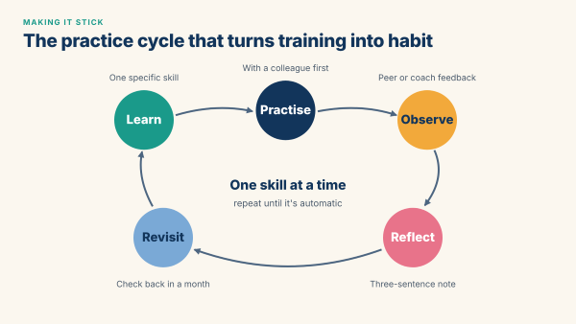
Whether you are a school leader planning a term of development or a teacher taking charge of your own, a few habits make a big difference:
- Pick one skill, not six. Choose something specific, like transitions or questioning and stay with it for several weeks.
- Practise before you perform. Rehearse with a colleague first. It feels awkward for about two minutes and then it is useful.
- Get watched, kindly. Peer observation and coaching turn “I think that went okay” into something you can actually work with.
- Write a short reflection. Three sentences after a lesson: what I tried, what happened, what I will change.
- Come back to it. Revisit the skill after a month. If it is slipped, that is normal. It is also exactly what follow-up is for.
Where NSED fits
NSED’s Teacher Training & Development programme runs over three to five days and focuses on teaching skills, classroom leadership and learner engagement through practical, certified modules. It’s built for teachers who want something they can use the following week, not just something to put on a CV.
If you are an institution looking to train a whole staff team, get in touch with us and we will talk through what would work for your context. You can also browse all NSED training programmes, including first aid, health and safety and safeguarding.
Final thoughts
Good classroom leadership is not a gift handed out at birth. It is a set of habits that get better with practice, feedback and a bit of patience. The best teacher training respects that. It gives teachers something specific to try, people to learn alongside, and enough time for the new habit to stick.
Start small. Pick one skill, try it this week, and see what changes in the room.
Sources and further reading
- Learning Policy Institute: Effective Teacher Professional Development (factsheet)
- Education Endowment Foundation: Effective Professional Development
- Education Endowment Foundation: Improving Behaviour in Schools
- Education Endowment Foundation: Teaching and Learning Toolkit, Feedback
- AITSL: Classroom management research spotlights
- OECD: Teaching and Learning International Survey (TALIS)