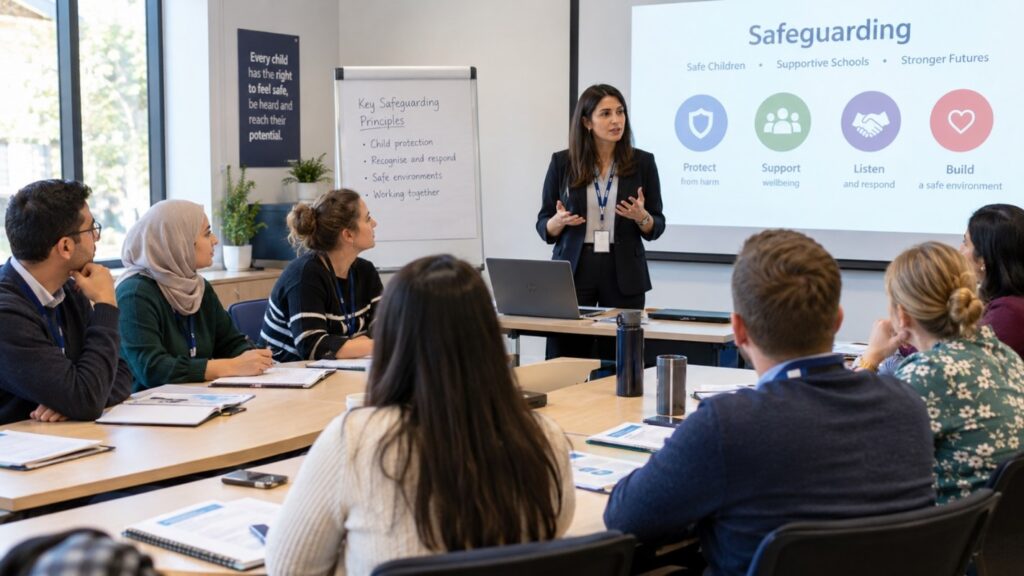
Most teachers can sense when something is not quite right in their classroom. A student who usually talks a lot suddenly becomes quiet. Someone who always completes their homework starts missing assignments. A child who once enjoyed spending time with friends at lunch begins sitting alone in the library. These changes may not always mean something is wrong, but sometimes they are early signs that a student is struggling with problems at home, facing bullying at school, or experiencing difficulties online.
Academic safeguarding helps schools recognise these warning signs and take appropriate action to protect students from harm. It provides teachers and school staff with guidance on identifying potential risks, responding to concerns, and ensuring that every student feels safe, supported, and valued. This guide explores what academic safeguarding means, the signs teachers should look out for, and the practical steps they can take to help students who may be at risk.
What is Academic Safeguarding?
Safeguarding is about keeping children and young people safe from harm while supporting their overall well-being. In schools, this means protecting students from abuse, neglect, bullying, online dangers, exploitation, and mental health challenges. However, safeguarding goes beyond responding to individual problems. It also involves creating a school environment where students feel safe, staff are properly vetted, concerns are recorded and addressed responsibly, and every child feels comfortable speaking up when something is wrong.
It is different from child protection though the two overlap. Child protection is the response when a child is already suffering or at risk of significant harm. Safeguarding is wider. It includes prevention, early help and everyday wellbeing.
If you teach in England, the main rulebook is the Department for Education’s statutory guidance, Keeping Children Safe in Education (KCSIE). The 2026 edition came into force on 1 September 2026. It says that all staff, not just the safeguarding team, share responsibility for providing a safe environment in which children can learn. Other countries have their own versions, but the principle is the same everywhere.
Why Schools are so Central?
Teachers see children nearly every day. They know what “normal” looks like for each student, which makes them well placed to notice when something changes. Schools have a duty to protect children from harm within the setting, and they’re also in a strong position to notice signs of abuse happening outside it. Similarly, there is a mental health angle too. The World Health Organization notes that up to half of all mental health conditions begin before the age of 14, and its guidelines on adolescent mental health recommend interventions that can be delivered in schools. Although teachers are not therapists and nobody expects them to be yet they are often the first adults to see the early signs.

Spotting the Signs
No single sign proves anything. Children are not always able to say what is happening to them, and some do not realise that what is happening is abuse. That is why patterns matter more than one-off incidents. Some of these patterns include:
- Behaviour: Sudden aggression, extreme clinginess, fear of particular people or places, reluctance to go home, or a sharp drop in confidence.
- Appearance and physical signs: Injuries without a believable explanation, clothing that seems chosen to cover the body even in warm weather, poor hygiene, or being consistently hungry or underdressed.
- Attendance and academic performance: This is where the “academic” in academic safeguarding often shows up. Repeated absence, lateness, trouble concentrating and a sudden fall in grades can all signal that something outside school is getting in the way. As the Mentally Healthy Schools site puts it, distress often comes out through behaviour and an inability to focus.
- Online life: Secretiveness about devices, distress after being online, or new contacts the student won’t talk about. Cyberbullying and online exploitation rarely stay online.
- Peer relationships: Sudden loss of friends, being the target of jokes, or, flipping it around, a student who is suddenly hurting others. Child-on-child abuse is a real part of safeguarding and gets plenty of attention in current guidance.
A student who gets good marks and never causes trouble can still be struggling. Quiet students are the easiest ones to miss.
When Something doesn’t Feel Right
This is the part people tend to overthink. One does not have to be certain. One does not have to investigate and confront anyone. One’s job is to notice, listen and pass it on.
- Listen without leading: If a student opens up, let them talk. Stay calm and do not ask questions that put words in their mouth.
- Never promise to keep it secret: It is tempting, because you want them to trust you. But you may have to share it, and breaking a promise later does more damage.
- Write it down quickly: Record what the student said in their own words, along with the date, time and anything one observed. Stick to facts rather than opinions.
- Tell your Designated Safeguarding Lead (DSL) the same day: In KCSIE, the DSL’s role is set out. They decide on next steps, which might include early help, or a referral to children’s social care or the police.
- Follow up: Check with the DSL afterwards and keep being a steady, ordinary adult in the child’s day.
However, many people hesitate because they are afraid of being wrong. A concern that turns out to be nothing costs a few minutes. A concern nobody raised can cost a child years.
Wellbeing is the Everyday Half of Safeguarding
Safeguarding is not only about emergencies. A lot of the work happens in ordinary, unglamorous ways such as greeting students by name, running predictable routines and making it clear that asking for help is normal.
The World Health Organization (WHO) includes school-based social and emotional learning programmes in its list of cost-effective interventions for mental health and it has produced a topic brief on school systems improving health and wellbeing with UNICEF and UNESCO. Anti-bullying programmes also work. Research shows that anti-bullying programs can reduce bullying by about 20%, as summarised in this school mental health infographic from the Child Health Task Force.
Safety affects learning directly. When UNICEF’s Lebanon launched a national child protection policy for schools, the organisation pointed out that violence in schools hurts attendance and academic results. A student who is scared can not concentrate, whatever the lesson plan looks like.
Small things that help:
- Build in regular, low-pressure check-ins, especially with students who have had a rough patch.
- Make sure every student knows at least one adult in the building they can go to.
- Teach emotional vocabulary and healthy relationships as part of the normal curriculum.
Take low-level behaviour seriously. “Banter” that targets someone is often where bigger problems start.

What School Leaders Need to Own
If you are a head teacher, principal or instructor, safeguarding culture starts with you. Policies on paper do not protect anyone unless staff understand them and feel confident using them. A few priorities:
- Make Reporting Easy: Staff should know exactly who the DSL is, how to reach them, and what a good report looks like. The system should never feel like a hassle.
- Train Everyone, Regularly: Induction for new staff, annual updates for everyone, and deeper training for DSLs.
- Recruit Carefully: Safer recruitment checks are a core part of the guidance.
- Review What is Happening: Look at patterns in concerns, attendance and incidents. If bullying keeps happening in the same corridor, that is information.
- Look after Your Staff: Dealing with disclosures is heavy. A DSL who has burned out can not protect anyone.
Getting the Right Training
Reading guidance is useful, but it is no substitute for practice. Training is where staff get to work through realistic scenarios, ask the awkward questions and build the confidence to act. NSED’s Academic Safeguarding & Wellbeing Training is a certified programme that helps educators identify risks, support student mental health and promote wellbeing within institutions.